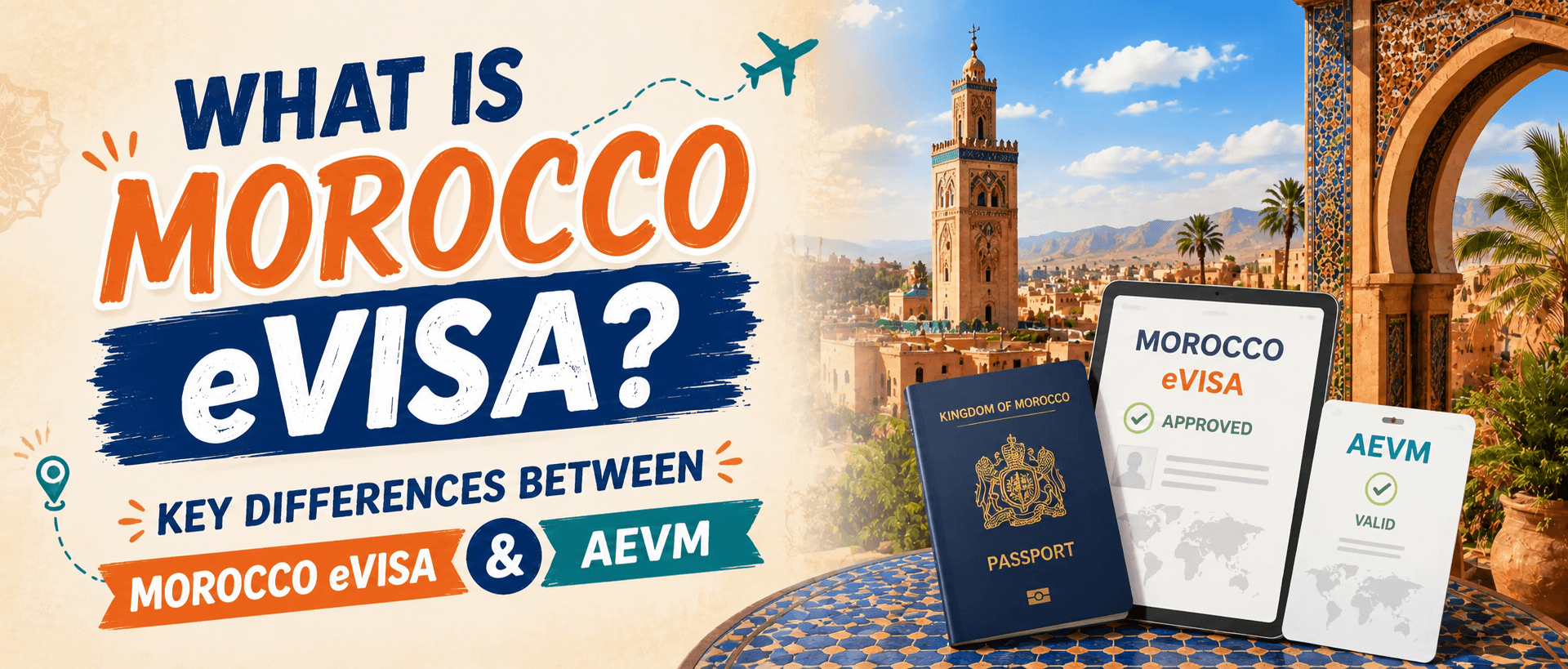
Planning a trip to Morocco but unsure whether you need to apply for an eVisa or register for AEVM? Although both procedures can be completed online, Morocco eVisa and AEVM are two different travel requirements, designed for different groups of travelers. If you confuse the two, you may submit the wrong application, face processing delays, or encounter unnecessary risks before your trip.
In this article, TODC will explain the key differences between Morocco eVisa and AEVM, helping you identify the right procedure to prepare before entering Morocco.
What Are Morocco eVisa and AEVM?
What Is Morocco eVisa?
Morocco eVisa, also known as the Morocco Electronic Visa, is an official electronic visa issued by the competent Moroccan authorities. This system is available through the official portal acces-maroc.ma, allowing eligible applicants to complete the visa application process online.
Instead of submitting paper documents directly at an Embassy, applicants only need to fill in the required information, upload supporting documents, and pay the visa fee online. Once the application is approved, the visa result will be sent to the applicant’s email.
Morocco eVisa generally applies to travelers who need a visa to enter Morocco but are eligible to apply through the electronic visa system. Key information about Morocco eVisa includes:
-
Maximum length of stay: 30 days
-
Visa validity: 180 days from the date of issuance
-
Number of entries: Single entry
-
Purpose of entry: Tourism or short-term business
-
Processing time: 72 hours for standard applications, 24 hours for urgent applications
What Is AEVM?
AEVM stands for Autorisation Électronique de Voyage au Maroc, which can be understood as an electronic travel authorization for Morocco. It is not a visa, but a form of pre-travel authorization required before entering Morocco.
AEVM usually applies to certain nationalities that are visa-exempt for Morocco but still need to register their information before the trip for review and confirmation. Travelers in this category do not need to apply for an eVisa, but they must complete the AEVM procedure if their nationality is subject to this requirement.
However, it is important to note that receiving AEVM approval does not guarantee entry into Morocco. Immigration officers at the border still have the authority to review your documents, travel purpose, and other entry conditions before making the final decision.
Morocco eVisa vs AEVM: Key Differences
Because both procedures can be completed online, Morocco eVisa and AEVM are often confused. The table below highlights the main differences:
|
Criteria |
Morocco eVisa |
AEVM |
|
Nature |
Official electronic visa |
Electronic travel authorization, not a visa |
|
Eligible applicants |
Travelers who need a visa to enter Morocco and are eligible for eVisa |
Visa-exempt travelers who still need to register for pre-travel authorization |
|
Purpose of entry |
Tourism or short-term business |
Tourism or short-term business |
|
Length of stay |
Up to 30 days |
Based on the visa exemption policy of each nationality, usually 30–90 days |
|
Validity |
180 days from the date of issuance |
Usually 30 days from the date of issuance |
|
Number of entries |
Single entry |
Single entry |
|
Processing time |
Around 24–72 hours, depending on the application type |
Usually from a few hours to 1 business day |
|
Application portal |
acces-maroc.ma |
acces-maroc.ma |
Who Is Eligible to Apply for Morocco eVisa?
Not all foreign nationals are eligible to apply for Morocco eVisa. Currently, Morocco’s eVisa system divides applicants into three main groups based on nationality, residence status, or a valid third-country visa.
Group A: Eligibility Based on Nationality
This group includes travelers who can apply for Morocco eVisa based on their nationality. Some countries in this group include Vietnam, India, Thailand, Israel, Jordan, Laos, Cambodia, Brunei, Azerbaijan, Benin, and Guatemala.
For this group, the basic requirement is a valid ordinary passport with at least 3 months of validity remaining from the date of application submission.
Group B: Eligibility Based on Residence Permit
Travelers of any nationality may also be eligible for Morocco eVisa if they hold a valid residence permit from certain countries or regions, such as the European Union, the United States, Australia, Canada, the United Kingdom, Japan, Norway, New Zealand, the UAE, or Switzerland.
In this case, the residence permit must be valid for at least 180 days from the date of eVisa application submission.
Group C: Eligibility Based on a Third-Country Visa
In addition to nationality and residence permit, Morocco also allows certain travelers to apply for eVisa if they hold a valid visa from a third country.
Specifically, applicants may be eligible if they hold a regular multiple-entry visa issued by Schengen countries, the United States, Australia, the United Kingdom, Ireland, Japan, Canada, Norway, or New Zealand. This visa must be valid for at least 90 days and is generally required to be a physical visa sticker on the passport, not an eVisa.
If you do not fall into any of the groups above, you are not eligible to apply for Morocco eVisa. In that case, the appropriate option is to apply for a traditional visa through a Moroccan Embassy or Consulate according to the relevant regulations.
Who Needs to Register for AEVM When Traveling to Morocco?
AEVM is not intended for travelers who need a visa. It applies to certain nationalities that are visa-exempt for Morocco but are still required to obtain pre-travel authorization before entry.
Currently, the nationalities commonly mentioned under the AEVM program include Congo Brazzaville, Guinea Conakry, and Mali. In addition, Morocco may expand or adjust this list during specific periods, such as when hosting major international events.
Because the list of countries requiring AEVM may change over time, travelers should not rely solely on outdated information or unofficial sources. Before departure, it is advisable to check directly on acces-maroc.ma to confirm whether you need to register for AEVM.
This is a small but important step, as missing a required authorization may cause difficulties during airline check-in or upon arrival at the Moroccan border.
Conclusion
Morocco eVisa and AEVM are both procedures that can be completed online, but they are different in nature. eVisa is an electronic visa for travelers who need a visa and are eligible to apply online, while AEVM is a pre-travel authorization required for certain visa-exempt nationalities.
Need assistance with your Morocco eVisa application? TODC supports eligibility checks, document preparation, and application tracking for Morocco eVisa, helping clients save time and reduce the risk of application refusal. Contact us today for a free consultation and prepare your Morocco eVisa application correctly from the start.